
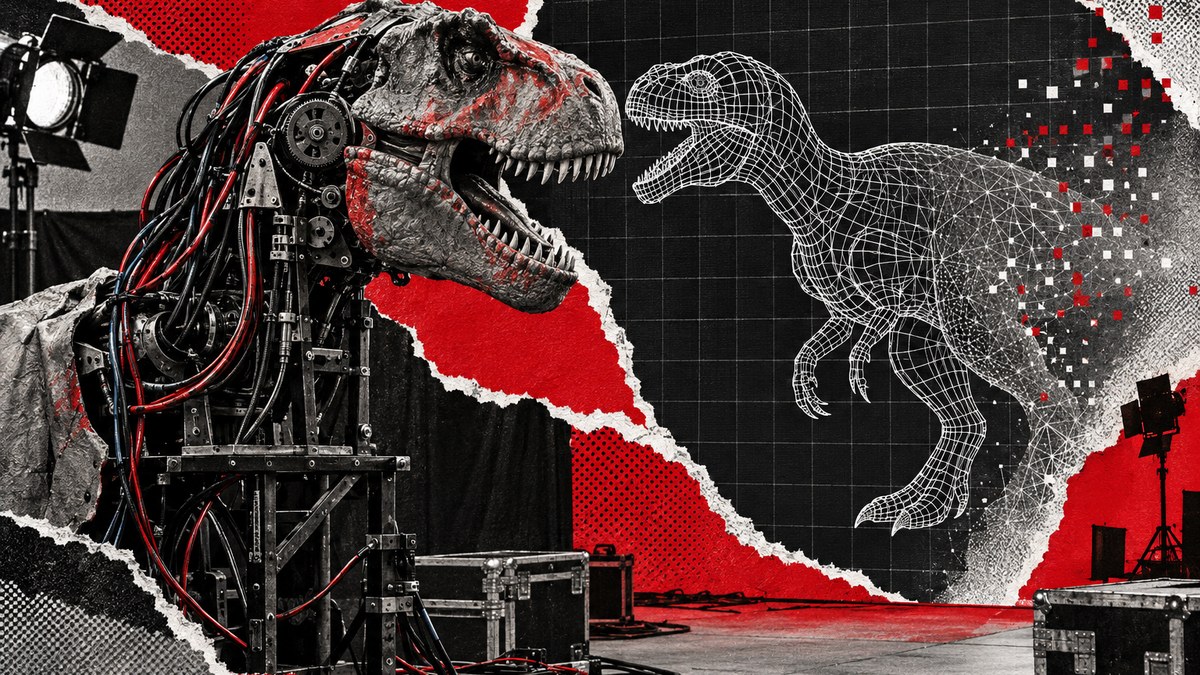
I watched Jurassic Park again last month on a rainy Sunday, the way you revisit an old friend to make sure they are still who you remember. The kitchen scene still got me. Two raptors, a steel counter, a ladle hitting the floor. I knew exactly what was coming, and my shoulders still went up around my ears.
Then I looked it up, because I always do, and found the number that made me write this post. The film has only about fifteen minutes of dinosaurs on screen. Roughly nine of those minutes are Stan Winston’s animatronics. About six are Industrial Light & Magic’s computer animation (The Conversation). The movie everyone credits with launching the CGI era is, by screen time, mostly puppets.
That is not a trivia footnote. I think it is the whole argument.
The movie that “started CGI” mostly didn’t use it
Here is my opinion, stated plainly so you can argue with it: the effects we remember are usually the ones that were physically in the room with the actors. Not always. Usually.
Jurassic Park worked because Spielberg used the new tool where nothing else could do the job, a herd running across a field or a T. rex in full stride, and used real, heavy, wet machinery everywhere else. The computer work was the exception that made the rule feel bigger. When the sick triceratops is lying on the ground and Laura Dern puts her hands on it, she is touching something. You can see it in her face.
That split, practical as the foundation and digital as the extension, is the part people forget when they say CGI “took over” in 1993. It didn’t. It was invited in as a guest.
What changes when an actor can touch the thing
I am not going to pretend I have a lab result for this. What I have is thirty-odd years of watching movies and noticing when my body believes what my eyes are seeing.
Filmmaking writers have landed on the same explanation I have. CGI didn’t win because it looks better. It won because it is cheaper, faster and gives a studio more control after shooting wraps (No Film School). Those are real advantages. But none of them is about what the audience feels.
A physical effect gives the actor something to react to. Light hits it the way light hits everything else in the shot. Dust falls on it. When it moves, it has weight, and weight is the thing our eyes are brutally good at judging. A digital creature can be flawless in every frame and still feel like it weighs nothing, because someone had to decide how much it weighs.
Fury Road and the case for building it for real
If Jurassic Park is the proof from the past, Mad Max: Fury Road is the proof from the present. George Miller said about 90% of the film’s effects were practical: real vehicles, real desert, real performers swinging on poles above moving trucks (Business Insider).
And here’s the part that keeps the argument honest: Fury Road still has thousands of visual effects shots. The digital work cleaned up rigging, extended the landscape and built Furiosa’s missing arm (Tom’s Guide). That is exactly the Jurassic Park formula thirty years later. Shoot the real thing, then use the computer to finish it, not to invent it.
Ten years on, it doesn’t look dated to me. A lot of 2015’s fully digital spectacle already does.
Where CGI genuinely earns its keep
I don’t want to be the guy yelling at clouds, rendered or otherwise. Some shots should be digital.
Film schools teach this plainly: long aerial shots, wide pans, and scenes too dangerous or too big to build are where CGI is the practical choice, because the audience can’t pick out fine detail at that distance anyway (Los Angeles Film School). Crowd extensions, weather, removing a safety wire from a stunt performer’s back: the best effects work of the last decade is stuff you never noticed.
And that is really my point. Good CGI is usually invisible. The CGI people complain about is the stuff that replaced something that should have been built.
Why practical effects age better
This is the question underneath the whole debate, and I have a simple theory. A practical effect is recorded. A digital effect is rendered.
When you film a puppet, you capture it with the same camera, lens and light as everything around it. It ages exactly as fast as the rest of the film, which means it ages gracefully. A rendered effect is locked to the software and the budget of the year it was made. When the tools improve, the old shot doesn’t get better. It just gets older in a different way than the rest of the frame.
That’s why a 1993 animatronic can look more convincing today than a creature from a movie made fifteen years later. The puppet was never competing with the future. It was just there.
What I want from the next blockbuster
I’m not asking for a return to rubber suits and nothing else. I’m asking for the Jurassic Park ratio: build what you can, animate what you must, and give the actors something real to be scared of.
Next time you watch a movie that stuck with you, try this. Pick the one scene you would describe to a friend. Then look up how it was made. I would bet my VHS collection that, more often than not, somebody built it.
— James Atkinson