
You know that feeling when a song comes on and your shoulders start moving before your brain has even decided whether you like it. Odds are, there’s a Latin rhythm somewhere under that track. A syncopated drum pattern, a clave pulse, a guitar figure borrowed from bossa nova. You might not name it, but your body already knows it.
By the time you finish reading, you’ll know where that sound came from, why it’s bigger right now than at any point in pop history, and which songs to queue up if you want to hear the influence for yourself.
The short version:
Latin music isn’t a niche corner of the charts anymore. It’s one of the main engines driving them. In the US alone, Latin music reached $1 billion in annual wholesale revenue in 2025, its 10th straight year of growth, and made up 8.8% of all recorded music revenue (RIAA). Nearly all of it, 98.2%, came from streaming (RIAA Latin revenue report).
That’s not a trend line. That’s a decade of listeners choosing it, over and over.
Here’s the full story behind it
Most people assume the Latin pop wave started with “Despacito.” It didn’t. Pop has been borrowing from Latin music for more than 60 years.
Go back to 1965, when “The Girl from Ipanema” by Stan Getz and Astrud Gilberto won the Grammy for Record of the Year (Recording Academy). That was bossa nova, a Brazilian blend of samba rhythm and jazz harmony, sitting at the very top of American pop. You can still hear its soft, swaying chords in lounge-pop and indie records today.
From there the influence never really left. Mambo and cha-cha-chá shaped big-band dance floors. Salsa came up through New York. Latin pop stars crossed over in waves through the 1990s and 2000s. Every era found its own way to fold those rhythms into whatever pop sounded like at the time.
This is where it gets interesting
The real shift came when the songs stopped translating themselves. For decades, crossover usually meant recording in English. Then in 2017, “Despacito” by Luis Fonsi and Daddy Yankee, with Justin Bieber on the remix, spent 16 weeks at No. 1 on the Billboard Hot 100, tying what was then the record for the longest run at the top (Billboard).
That opened the door, and streaming kept it open. On a streaming app, there’s no radio programmer deciding whether a Spanish-language song “fits” an English-language station. You press play, and if the song moves you, it moves up.
By 2025, Bad Bunny was the most-streamed artist on Spotify worldwide for the fourth time, with 19.8 billion streams that year (Spotify). Then in February 2026, his album “Debí Tirar Más Fotos” became the first all-Spanish-language album ever to win the Grammy for Album of the Year (AP News). A week later, his Super Bowl halftime show drew 128.2 million viewers (Reuters).
Why it works on your ears
That’s not luck. Latin rhythms are built to make you move. A lot of them rest on syncopation, accents that land just off the beat you expect, and that small surprise is what makes your foot tap. Reggaeton’s signature drum pattern, sometimes called the dembow, repeats in a way that feels steady and restless at the same time.
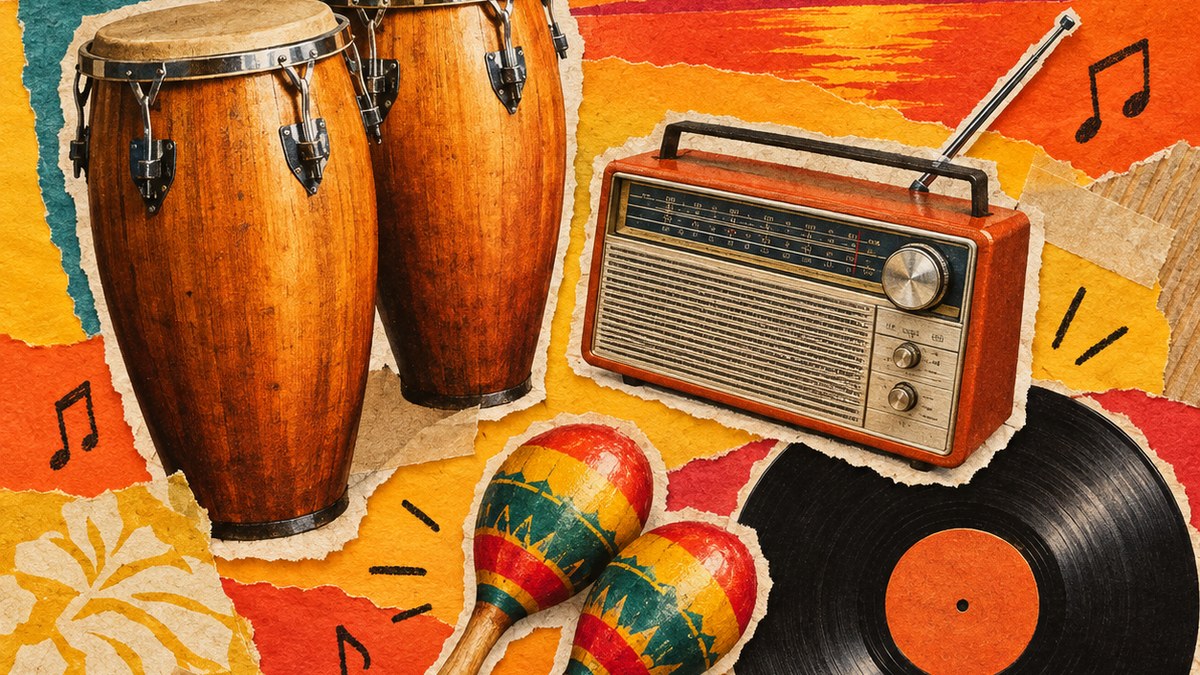
There’s also the percussion itself. Congas, bongos, timbales, shakers and claves add texture that a drum machine alone can’t fake. When a pop producer layers a live conga under a synth line, the track suddenly feels warmer and more human. You hear it as energy, even if you can’t point to where it’s coming from.
And melody matters, too. Bossa nova and bolero brought rich, jazzy chords into pop. Those chords give a song emotional color, a little bittersweet, a little nostalgic, which is exactly the mood a lot of pop is chasing right now.
Who’s carrying it forward
The big names are easy to spot, but the influence runs deeper than the charts. It shows up across genres and in artists you might not expect.
Some artists pull from Latin percussion and jazz harmony to build something cinematic rather than club-ready. LA vocalist Ashley Ann is a good example: her sound pairs jazz-inflected melodies and Latin percussion with a contemporary pop lens, which her official site describes as cinematic nostalgia with a modern edge (AshleyAnn.Global). It’s a reminder that the Latin influence in pop isn’t only reggaeton beats. It’s also the hand drum under a torch song, or the bossa-style chord that makes a hook feel like an old movie.
We think that range is the real story. The influence isn’t one sound. It’s a whole toolbox, and more pop artists are reaching into it every year.
Build your Latin-influenced queue
If you haven’t listened for the Latin roots in your playlists before, here’s an easy way to start. Queue these up in order and listen for the rhythm under each one.
- “The Girl from Ipanema” (Stan Getz and Astrud Gilberto, 1964). Start with the bossa nova blueprint. Notice the soft guitar rhythm and the jazzy chords.
- “Oye Como Va” (Santana, 1970). Latin rock with timbales and a cha-cha-chá groove that never gets old.
- “Despacito” (Luis Fonsi and Daddy Yankee, 2017). The modern crossover moment. Listen for how steady that beat stays.
- A track from “Debí Tirar Más Fotos” (Bad Bunny, 2025). The record that made Grammy history. Listen for how much rhythm carries each track.
- A newer artist you’ve never heard. Search a Latin pop or Latin jazz playlist and pick something from the bottom half. That’s where the next wave is hiding.
Bookmark this list and come back to it. You’ll start hearing those rhythms in songs you thought you already knew.
Start a playlist tonight
Here’s our challenge for you: start a playlist called “Latin Roots” and add one song every time you catch that rhythm in something unexpected. A conga in a ballad. A clave pattern in a dance track. A bossa chord in an indie song. Genuinely, once you start hearing it, you can’t stop.
Then send it to a friend and ask what they would add. We’d bet they find one you missed.
Veronica Barry, October 15, 2026