
I need to tell you about the best kind of movie discovery, because I think we’ve all forgotten it exists: the accidental one.
I landed on Turner Classic Movies mid-introduction. The host was already three sentences into setting up some black-and-white comedy from 1939, and my thumb was hovering over the remote, ready to keep scrolling like I always do. And then, for no good reason, I didn’t. I just let it play. No trailer, no plot description, no five-star Letterboxd consensus to prime my expectations. Just a title card — Bachelor Mother — and a decision to roll with it.
That decision gave me a new favorite movie, and I’m not being dramatic. It gave me one of the purest viewing experiences I’ve had in years, because I had absolutely no idea what I was walking into.
What You’re Actually Watching
Bachelor Mother is a 1939 RKO screwball comedy directed by Garson Kanin, starring Ginger Rogers as Polly Parrish, a department store shopgirl about to lose her seasonal job right before Christmas (TCM). On her way out, she stops a baby from tumbling down the steps of an orphanage — and in the space of about ninety seconds, everyone around her decides the baby is hers. She says otherwise, repeatedly, to absolutely nobody’s satisfaction. David Niven plays David Merlin, the playboy son of her boss, who gets pulled into the lie and slowly falls for her instead of untangling it. Charles Coburn plays his father, who becomes so thrilled at the idea of a grandchild that he refuses to hear any version of events that doesn’t include one (Wikipedia).
I’m going to stop the plot summary there on purpose. Part of what made this film land so hard for me is that I didn’t know where any of it was going, and I think that’s exactly how it should hit you too. If you’ve never seen it, go in cold. That’s the whole pitch of this article.
Ginger Rogers Deserved Better Than “Fred Astaire’s Partner”
Here’s my opinionated take, and I’ll defend it: Ginger Rogers is one of the most criminally undersold comedic actresses of her era, and this movie is the proof. She spent so much of her career being talked about as one half of a dance duo that her solo work as a comedic lead barely gets mentioned in the same breath — and Bachelor Mother is her running away with an entire film on wit, timing, and sheer nerve alone.
Critics at the time saw it too. The New York World-Telegram wrote that she “dominates the proceedings from beginning to end with her radiant personality and fine acting,” and Variety praised the film’s “excellently tempoed lines and situations” carried by a “top-notch cast” (TCM). Rotten Tomatoes’ retrospective write-up calls it “an appealing premise employed to low-key yet watchable effect” that still “has a lot to say about the way we treat women and mothers” (Rotten Tomatoes). And a more recent fan write-up gets right to the point I want to make: “Ginger Rogers is perfection itself at every point of this film. Where is her dang Oscar?” (Cinema Or Whatever).
She should have won something for this. She didn’t, and I think that’s a small crime worth mentioning eighty-plus years later.
The Donald Duck of It All
Now, the detail that made me sit up: Donald Duck is in the credits. Not a cameo, not a poster — an actual line in the cast list reading “Donald Duck … Himself” (AFI Catalog).
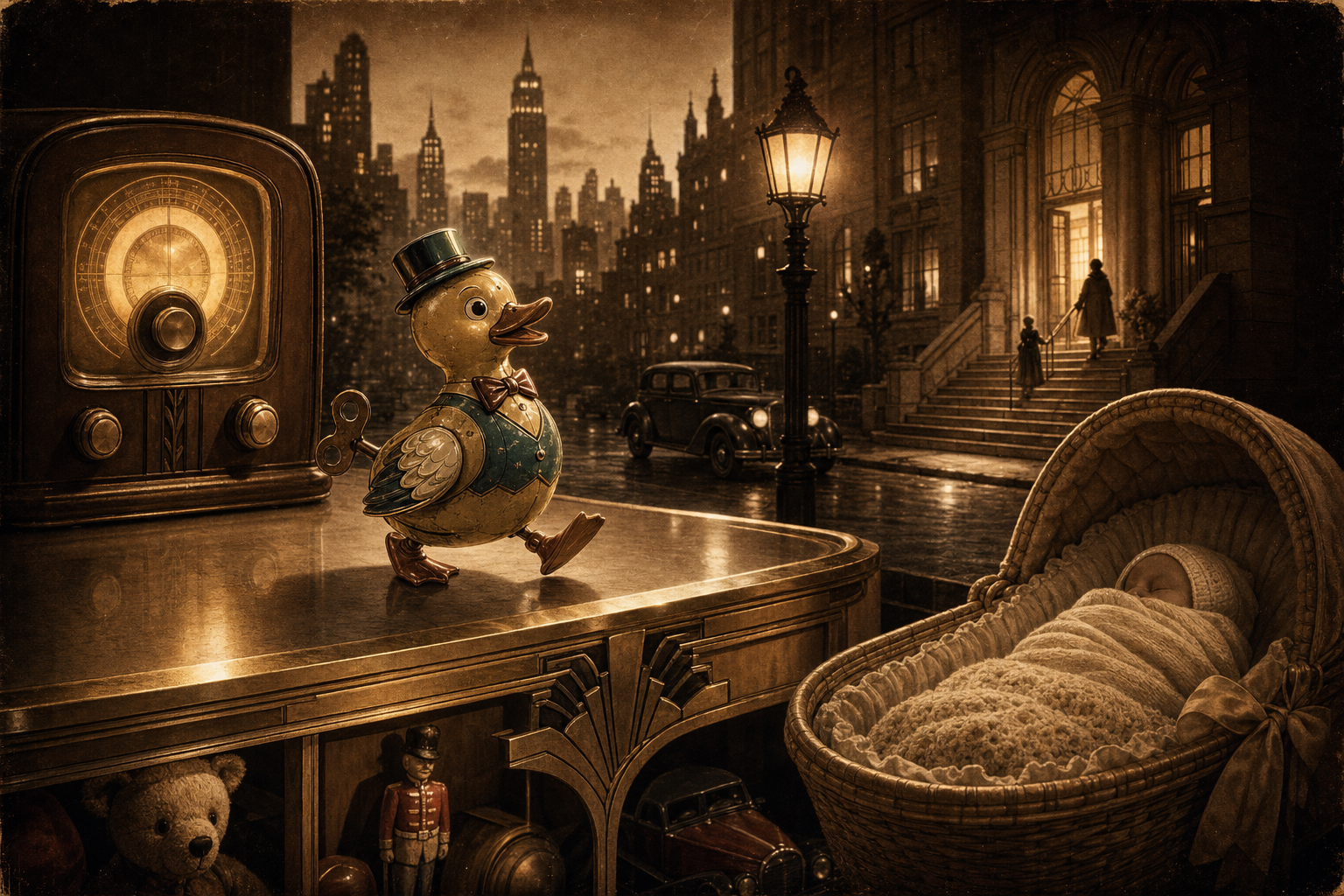
Here’s the joke, and it’s a good one: Polly’s day job before the baby chaos is working the toy counter, winding up mechanical Donald Duck toys so they waddle and quack across the display table for customers (LinkedIn / Steve Rubin). It’s a running bit throughout the film, and it pays off in one of the funniest sequences I’ve seen in a movie this old: David Niven’s character tries to do the simple, humiliating task of exchanging a broken toy duck — at his own family’s store — and can’t manage it (Mike’s Take On the Movies). RKO distributed Disney’s output at the time, which is the practical reason Donald shows up at all, but the film treats him less like corporate synergy and more like a genuine, quacking supporting character (Comet Over Hollywood). It’s a strange little relic of studio history, and it works.
The Moment I Realized Ginger Rogers Looked Familiar
Now for the part of this discovery I didn’t see coming at all.
Somewhere around the film’s midpoint, I caught myself staring at Ginger Rogers thinking: I know this face. Not from her other films — from somewhere else entirely. It was in certain angles, in a particular tilt of the head, in the cadence of her line delivery. It clicked a few scenes later: she reminded me of Lucille Ball. Not a passing resemblance — the mannerisms, the comic timing, even the tone of her voice in the sharper exchanges felt like watching an early draft of Lucy.
So I looked it up, fully expecting to find nothing, because that’s usually how these hunches go.
I was wrong. Ginger Rogers and Lucille Ball were, in fact, related — distant cousins, reportedly four or five times removed on their maternal side, a connection the two of them discovered themselves after they’d already become close friends on the RKO lot (Morning Honey; Wikipedia). Rogers’s mother, Lela, ran an in-house acting workshop at RKO and personally mentored a then-unproven Lucille Ball, coaching her through the confidence issues that nearly derailed her career before it started (Wikipedia).
And then I found the detail that actually gave me chills: Lucille Ball didn’t just know Ginger Rogers. She later played this exact role. Polly Parrish, the character I’d just watched Rogers originate, was performed by Lucille Ball herself in two separate radio adaptations of Bachelor Mother — a 1949 broadcast of The Screen Guild Theater opposite Joseph Cotten and Charles Coburn, and a 1951 Screen Director’s Playhouse production opposite Robert Cummings (Wikipedia). My eyes weren’t playing tricks on me. I had accidentally clocked a real, documented family and creative lineage from a facial expression and a line reading, with zero prior knowledge that any connection existed. That’s the kind of thing that makes classic film genuinely addictive.
The Verdict
Bachelor Mother isn’t a hidden masterpiece nobody’s heard of — it turned a real profit for RKO, made the American Film Institute’s list of nominees for the 100 funniest American movies, and has a devoted pocket of classic-film fans who consider it one of the best comedies of 1939, a year regularly cited as the strongest in Hollywood history (Wikipedia; Classicfilmfan). What it is, is underexposed relative to how good it actually is — overshadowed by louder, more frequently revived titles from the same year.
I’m not going to tell you the ending. I’m going to tell you to find this movie the way I did: unplanned, mid-introduction, with no idea what you’re about to watch. Let it surprise you the way it surprised me — twice, actually, once with the story, and once with a family tree I never expected to stumble into.