
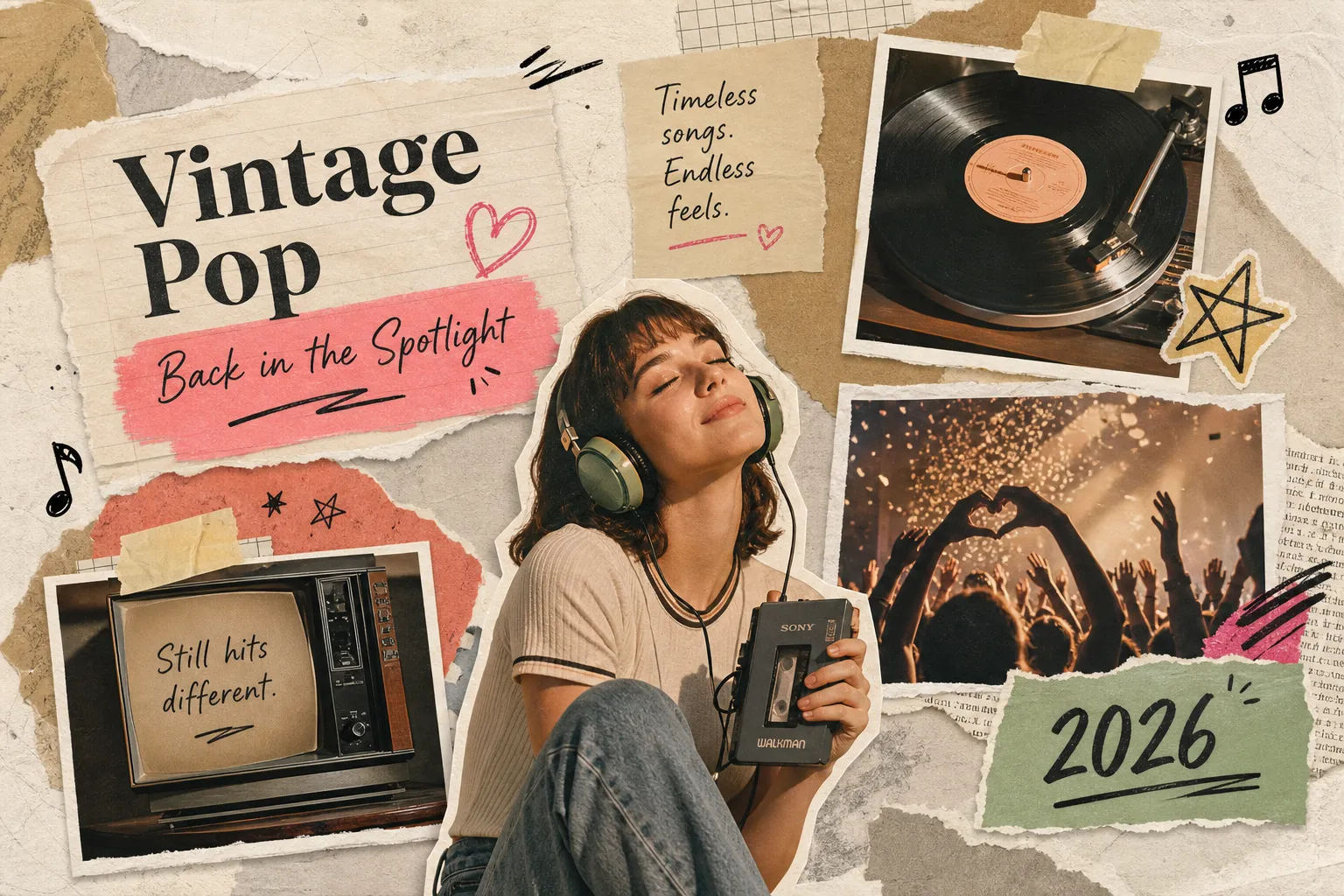
You’re scrolling through a playlist, expecting another over-compressed, algorithm-approved banger, and then something stops you completely. Strings swell. A melody unfolds like it has nowhere to rush. A voice leans into a phrase with the kind of emotional confidence that doesn’t need auto-tune to make its point. That’s vintage pop music doing exactly what it was built to do: cut through the noise by ignoring it entirely.
The genre has been quietly building momentum for years, but 2026 feels like the moment it stepped fully back into the room. Younger listeners are actively seeking out classic pop hits from the 1950s through the 1980s. Throwback pop playlists are racking up millions of followers on streaming platforms. And a new wave of indie artists is drawing directly from the same well. Los Angeles singer-songwriter Ashley Ann, whose debut work at AshleyAnn.Global sounds like it was pulled straight from a golden-era Hollywood session, is proof that this movement has real artists behind it, not just nostalgia-drunk algorithm editors. Something genuine is happening here. Here’s where it starts.
What actually defines the vintage pop music sound
The orchestral backbone that sets it apart
The most immediately recognizable feature of traditional pop and vintage pop music is the arrangement: lush string sections, woodwind accents, big-band rhythm sections anchored by upright bass and brushed drums. These instruments don’t just back the vocalist; they breathe with the song. Compare that to today’s production-heavy, sample-driven tracks, and the difference isn’t just aesthetic. It’s visceral. One feels like it was performed in a room by humans who could hear each other; the other sounds like it was assembled in a grid.
Melody-first songwriting and jazz harmony
Vintage pop music often prioritizes the melodic line over rhythm-driven hooks, the groove, and the beat. Jazz-influenced chord progressions, AABA song structures, and emotionally interpretive vocal delivery are the foundation. The melody doesn’t just deliver lyrics; it carries feelings the lyrics can’t quite reach on their own. That’s what makes these songs feel complete in a way that many modern tracks simply don’t.
The production warmth listeners can’t stop chasing
Tape saturation, natural reverb, and close-mic vocal intimacy created a warmth in pre-digital recordings that most engineers and listeners agree no plugin has fully replicated. Modern listeners raised on digital precision often describe vintage pop as sounding “warm” or “alive.” The explanation is analog texture: slight imperfections, natural room sound, and the way a voice sits in a mix like it belongs there. It’s emotionally disarming in the best possible way.
The mid-century Hollywood era that built the blueprint
Sinatra, Doris Day, and the art of the crooner
Frank Sinatra, Doris Day, and Bing Crosby didn’t just make records; they turned studio sessions into cinematic experiences. Their vocal phrasing was conversational but perfectly controlled. The arrangements gave them space to interpret rather than just deliver. The emotional restraint of the songwriting, the way a lyric could say one thing and mean three others, created a template that modern vintage-pop artists return to again and again because it still holds up completely.
How film scores shaped pop’s emotional vocabulary
The Hollywood orchestration of the 1940s and 1950s established the sweeping, emotionally direct sound that later defined traditional pop records. Composers writing for the screen used large studio orchestras of 80 to 100 players, rich string writing, extended harmonies, and lush melodic themes designed to move audiences without a single word. Pop arrangers borrowed that entire aesthetic. The Great American Songbook grew directly from this world, and the vintage pop sound still carries its DNA.
Girl groups, the British Invasion, and the next wave
The blueprint evolved through the 1960s without losing its core. Girl groups like The Supremes added tight harmonies and romantic urgency, bringing emotional directness to the forefront. The British Invasion contributed energy and sophisticated songwriting craft that kept the vintage pop tradition alive in a rock-adjacent frame. The melody-first philosophy survived the shift, even as the rhythm section got louder and the production got brighter.
The era-by-era evolution every vintage pop music fan should know
1940s and 1950s: traditional pop and the standards era
This is the foundation. Sinatra, Nat King Cole, and Patti Page defined a sound that was orchestral, warm, and built for emotional interpretation rather than radio immediacy. Songs followed elegant lyrical traditions and used jazz harmony to create a sense of sophistication without alienating mainstream listeners. These are the oldest roots of the genre, and they still feel effortlessly sophisticated today.
1960s and 1970s: vocal pop, sunshine pop, and soft rock
The genre evolved without abandoning its melodic core. The Beach Boys and The Mamas and the Papas brought harmony-rich sunshine pop to the forefront. The Carpenters followed with impeccable production and emotionally direct songwriting that defined a generation. Motown gave the tradition a rhythm and soul upgrade. By the 1970s, soft rock carried these values into a more polished commercial sound, while ABBA proved that vintage pop sensibility and chart-topping accessibility were not mutually exclusive.
1980s synth-pop and the last great analog era
The final chapter before digital took over is where many modern retro-pop artists do their most direct borrowing. Cyndi Lauper, Whitney Houston, and early Madonna kept the melodic tradition alive while production shifted toward synthesizers and polished studio craft. Songs still centered the emotional experience of the listener, even as the instruments changed. This is the era that most throwback pop compilations and playlist algorithms default to when they want immediate emotional impact.
Why 2026 listeners are reaching back for something timeless
Digital fatigue and the craving for warmth
Modern streaming has given listeners access to everything, and that abundance has accelerated a kind of sonic exhaustion. Heavily processed, maximalist production blurs together after a while. Vintage pop music’s warmth and space feel like the sonic equivalent of putting your phone down and sitting somewhere quiet. It doesn’t compete for your attention aggressively; it earns it.
Nostalgia as emotional architecture, not just sentimentality
There’s a useful distinction between cheap nostalgia and the deeper emotional resonance that classic pop hits provide. These songs were built around universal human experiences, handled with genuine care and craft. According to Luminate’s 2026 music consumption data, U.S. listeners ages 18 to 34 were the most likely to play music specifically to evoke a nostalgic mood. That’s not accident; that’s emotional intelligence. A 22-year-old who wasn’t alive when a Doris Day record came out can still feel it completely because the feelings encoded in the song were never dated to begin with.
How streaming algorithms quietly brought it back
Spotify’s “All Out 80s” playlist, with over 11.9 million followers as of mid-2026, and “All Out 2000s” at 12.9 million followers, introduced throwback pop to younger audiences who might never have found it through traditional discovery channels. Streaming didn’t just preserve vintage pop music; it handed it to a generation with fresh ears and no gatekeeping instincts about what counts as “their” era. That’s a genuinely powerful cultural handoff.
The artists breathing new life into the vintage pop sound
Ashley Ann and the Old Hollywood-inspired debut
Not every artist who reaches for a vintage sound actually understands it. Ashley Ann does. The Los Angeles singer-songwriter behind AshleyAnn.Global brings a genuinely personal connection to the vintage pop tradition: her musical identity was shaped by her love of her late grandmother and discovering jazz through classic Hollywood film scores. That origin story is not a marketing angle. It’s audible in the music.
Her debut single “Lemons” and the upcoming EP “Tools of Survival” draw on jazz-inflected melodies, Latin percussion, and the kind of cinematic warmth that belongs on a mid-century film score. In the artist’s own framing, her sound connects to the Doris Day and Frank Sinatra era that defined vintage pop’s DNA, filtered through real emotional experience and a modern indie sensibility.
She writes about resilience and self-discovery with the same emotional restraint and melodic care that made those original recordings last decades. That’s not retro cosplay. That’s lineage.
How modern retro-pop artists are bridging then and now
Ashley Ann isn’t an outlier. Artists like Brigitte Calls Me Baby and Elise LeGrow are among those operating in the vintage and retro-pop territory right now, treating old sounds as a living vocabulary rather than a costume. The throughline is always the same: a commitment to melodic songwriting, emotional honesty, and the kind of arrangement care that makes a song feel complete on first listen. When that sensibility meets modern independent distribution, the result is a vintage pop revival that belongs to no single label and no single era.
Jazz influence as the connective tissue
Jazz harmony keeps showing up in modern vintage pop music because it adds something pure pop often avoids: emotional range. Extended chords, ii-V-I progressions, and behind-the-beat vocal phrasing create a sense of musical conversation rather than pure proclamation. Artists who come to pop through jazz tend to write melodies that feel resolved and emotionally complete rather than hook-dependent. That’s a quality listeners respond to even when they can’t name it technically, they just know the song feels like it means something.
Where to start streaming vintage pop music tonight
The curated playlists worth following right now
The fastest on-ramp for newcomers is Spotify’s editorial All Out series. “All Out 80s” and “All Out 2000s” have built massive followings for good reason: the curation is consistent, the pacing is strong, and the playlists genuinely represent their eras without being overly obvious about it. Apple Music’s ’80s Hits Essentials and R&B Throwback playlists offer comparable quality for listeners on that platform. YouTube’s official artist channels for The Carpenters, ABBA, and Frank Sinatra are also worth exploring for deeper catalog cuts that editorial playlists often miss.
Songs to bookmark from each era
If you want a quick primer on how the sound evolved, start with these anchor tracks from the vintage pop songs canon:
- 1960s traditional pop: “Can’t Help Falling in Love” by Elvis Presley (released 1961), warm and unhurried, the melodic tradition at its most direct.
- 1960s vocal pop: “California Dreamin'” by The Mamas and the Papas, harmony-rich and cinematically nostalgic.
- 1970s soft pop: “Dancing Queen” by ABBA, the rare song that is simultaneously sophisticated and completely joyful.
- 1980s retro: “Time After Time” by Cyndi Lauper, a masterclass in emotional melodic writing that still holds up on any playlist.
- Modern vintage pop: “Lemons” by Ashley Ann at AshleyAnn.Global, where the Old Hollywood lineage meets 2026 indie sensibility.
How to build a vintage pop playlist that actually flows
A well-built vintage pop playlist doesn’t sound like a history lesson. It sounds like a mood. Think roughly a quarter traditional pop from the 1950s, about a third devoted to 1960s vocal pop and girl-group material, a fifth from 1970s soft pop and sunshine pop, another fifth from 1980s synth-pop and new wave, and a small handful of modern retro-pop tracks to keep things feeling alive rather than archival. That mix maintains the cohesive nostalgic warmth while giving listeners enough variety to stay engaged through the whole thing without feeling like they’ve heard the same decade on repeat.
The enduring case for music that refuses to date itself
Vintage pop music isn’t popular again because people are bored with the present. It’s popular because it was built around something the present still needs: melody, warmth, and human feeling that doesn’t hide behind production. These songs were crafted with care for listeners who deserved to feel something real. That value proposition hasn’t changed. The formats have changed. The streaming numbers have changed. The core transaction between artist and listener has not.
The artists who understand that, from Sinatra to Doris Day to a Los Angeles singer-songwriter releasing her debut EP in 2026, are not selling nostalgia. They’re offering a reminder of what music can be when it prioritizes emotion over immediacy. That’s not a trend. That’s a standard worth returning to.
Start a throwback pop playlist tonight. Bookmark Ashley Ann’s work at AshleyAnn.Global and add “Lemons” to the queue. Then find a quiet twenty minutes and let the strings do what they were always meant to do.
Pingback:Why Songs Get Stuck in Your Head (and Why It's Always the Same 20 Seconds) - Music Movies Madness Why Songs Get Stuck in Your Head: The Earworm Science