
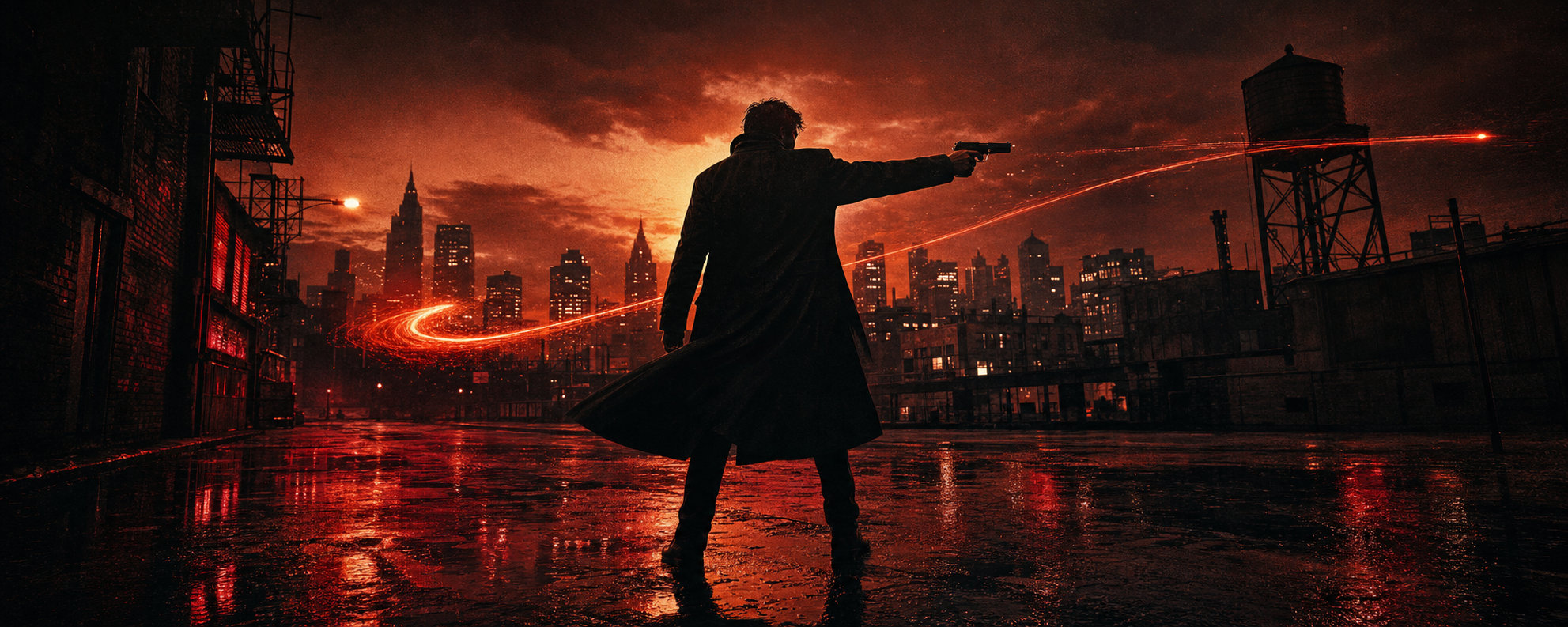
Here’s an unpopular opinion I’ll die on: Wanted is one of the best action movies of the 2000s, and most people underrate it because they can’t get past how ridiculous it is on paper. Curving bullets. A “Loom of Fate” made of thread. A guy who turns panic attacks into superpowers. Say it out loud and it sounds like a movie that shouldn’t work.
It works. It’s one of my personal favorites, and I’ll tell you exactly why.
The Setup, Fast
Wesley Gibson (James McAvoy) is stuck in the most familiar kind of hell: a cubicle job he hates, a girlfriend who’s cheating on him with his best friend, and panic attacks he manages with pills. Then Fox (Angelina Jolie) shows up, tells him his dead father was a professional assassin, and pulls him into the Fraternity — a secret society run by Mr. Sloan (Morgan Freeman) that “reads” a loom of fabric to identify people destined to cause mass suffering, then eliminates them before they can (Wikipedia).
Wesley’s panic attacks, it turns out, are actually a rare genetic ability that floods his system with adrenaline, giving him inhuman speed, strength, and precision (Wikipedia). He trains. He kills. He eventually finds out the whole Fraternity has been quietly corrupted, and he has to decide whether free will or fate actually runs his life. That’s the movie. Director Timur Bekmambetov never asks you to believe any of it is real — he asks you to believe it’s cool, and honestly, that’s the smarter ask.
What Everyone Gets Wrong About This Movie
The knock on Wanted has always been “style over substance,” and I’d push back on that framing entirely. Style is the substance here. This isn’t a movie failing to be The Bourne Identity. It’s a movie succeeding at being something else — a hyper-stylized, self-aware comic book fantasy that knows exactly what it is and never blinks.
Critics landed roughly where you’d expect for that kind of film: Rotten Tomatoes has it at 71% from critics with a 69% audience score, and the consensus nails it pretty fairly — “stylish, energetic popcorn fare” carried by witty performances from Jolie, McAvoy, and Freeman, held together despite an “absurdly over-the-top plot” (Rotten Tomatoes). Even critics who weren’t fully on board admitted the thing is fun — one called it “too bloody, too over the top, too silly, and too special effects driven” and then, in the same breath, “excessively entertaining” (Rotten Tomatoes). That’s the whole review, honestly. Both things are true, and only one of them matters if you’re having a good time.
And audiences agreed with their wallets — the film pulled in $342.5 million worldwide on a fraction of that in production costs (Wikipedia). Popcorn movies don’t need permission to be good. They need to deliver, and this one does — the parkour chases through Chicago, a bent-bullet assassination staged like a magic trick, an exploding rat used as a weapon, a full train derailment shot with real train cars instead of leaning entirely on CGI (Wikipedia). You feel the craft even when the physics make no sense.
The Real MVP: Danny Elfman’s Score
Here’s the part people sleep on, and it’s the part I actually want to talk about most: Danny Elfman’s score is doing more work in this movie than almost anyone gives it credit for.
Elfman signed on because he was a fan of Bekmambetov’s earlier films, and he described Wanted as a “weird, twisted, sarcastic thing” — which is exactly the brief he wrote to (Wikipedia). Instead of leaning on his usual gothic-orchestral instincts, he built the score around a guitar-driven, heavy-metal-adjacent approach, layered with techno textures and a Russian and Eastern European influence that mirrors the Fraternity’s own identity (Wikipedia; Film Intuition). He also wrote and performed “The Little Things,” the rock track that opens the film and closes it — his first vocal performance on a score in three years at that point (Wikipedia; Film Intuition).
Soundtrack critics who cover Elfman’s catalog closely called this “his best in years” and “Elfman at his very best” — eclectic, offbeat, memorable, and in the reviewer’s words, “much more successful… than the film itself” (Film Intuition). I wouldn’t go quite that far — I think the film and the score are doing the same job in tandem — but I understand the impulse. Tracks like “Fox’s Story” open on a somber, almost vulnerable register before the electric guitar rips through and reveals “the deadly woman underneath,” and “Revenge” is the moment Elfman fully cuts loose, throwing strings, guitar, and techno at each other until the track basically becomes the action sequence it’s scoring (Film Intuition). That’s what a great action score should do — not decorate the scene, but argue for it.
As a songwriter, this is the thing that keeps me coming back to Wanted more than the bullet curves or the Jolie car chase. Elfman understood that a movie this unapologetically stylized needed a score willing to match its nerve, not soften it. He didn’t play it safe, and the film is better for it.
The Verdict
Wanted isn’t trying to be a smart movie about fate versus free will, and it doesn’t need to be. It’s a confident, well-crafted, self-aware genre film with three actors clearly having a great time, action sequences built with real ambition, and a Danny Elfman score that might be doing the most interesting work in the whole production. If you dismissed it in 2008 as dumb popcorn action, I’d gently push back: it’s popcorn action that knew precisely what kind of movie it was, executed that vision without apology, and hired one of the best composers alive to make sure the whole thing actually sounded as dangerous as it looked.
That’s not a movie failing to be more. That’s a movie succeeding at being exactly what it set out to be — which, in my book, is worth more.